Tuesday, 22 November 2016

Wednesday, 16 November 2016
Thursday, 26 May 2016
WHAT CAN BE RECYCLED
 On the surface ‘Recycling’ seems clear and simple,
however as you go deeper into the process you
realise that things can get a bit tricky, when you discover that some
glass, paper and lots of plastic can’t be recycled. Actually throwing out items into the
recycling bin that you were convinced can be recycled, but actually can’t be,
can worsen the environment…what a downer!
On the surface ‘Recycling’ seems clear and simple,
however as you go deeper into the process you
realise that things can get a bit tricky, when you discover that some
glass, paper and lots of plastic can’t be recycled. Actually throwing out items into the
recycling bin that you were convinced can be recycled, but actually can’t be,
can worsen the environment…what a downer!
However since most people are aware of the
importance of recycling and the benefits it can provide to the environment, please continue!
Also note: Recycling regulations vary depending on where you live and what kind of facilities are in your community.
Please visit our other sites:
www.mother-nature-blog.comwww.facebook.com/motherearth.environmentalpollution
Wednesday, 25 May 2016
20+ THINGS THAT YOU SHOULD NOT THROW IN THE COMPOST HEAP
 1.
Bread – In
this category, cakes and pastas have been included. All forms of residue left
behind are a magnetized attraction for unwanted pests.
1.
Bread – In
this category, cakes and pastas have been included. All forms of residue left
behind are a magnetized attraction for unwanted pests.
2.
Cooking oil – It
is perceived as food by pests. Also its chemical content can upset the balance
of nutrients in the compost.
3.
Dairy products – Like
bread or grain products, these products are also a favoured food source for
pests and can also attract wildlife or flies..
4.
Diseased plants – These
carry fungus and harmful bacteria which can be transferred to the organic
nutrients of the compost heap.
5.
Plants that challenge and invade – Otherwise known as weeds, these plants won’t decompose
but grow instead.
6.
Faeces – The
bacterial content from both human and carnivorous animals, mainly to do with
consumed meat, is hazardous which might contain pathogens.
7.
Meat scraps – Apart
from the bacterial hazard, contents such as blood, bones and fleshy residues
are also attractive to pests.
8.
Heavily coated paper – These
are broadly categorized to include things such as greeting cards, magazines and
writing pads. Apart from its chemical content, its high foil content is
non-compostable.
9.
Coated or Printed paper – One
simple trick to use as a sticky reminder is to simply never print. There is no
longer a need to do this and its impact on the environment remains negative.
10.
Rice – In two parts, rice
is unsuitable for the compost heap. Raw rice is attractive to pests, while
cooked rice is fertile ground for bacteria, potentially harmful to the
compost’s nutrients.
11.
Sawdust – It
is not feasible to identify whether wood has been treated with chemicals and
other harmful ingredients or not. It is better not to toss sawdust into the
compost heap at all.
12.
Used personal items – All
used personal items such as tampons and diapers are soiled with human fluids
and are health hazards.
13.
Tea and Coffee bags – Tea and coffee should only be added in compose pile if
they are bag less. Some bags contain synthetic fibres that do not break down in
a compost pile.
14.
Citrus Peels, onions and garlic scraps – They should be avoided as they might scare of useful
bacteria and insects or kill worms and other organisms..
15.
Coal ash – It
may contain so much sulphur that it may make soil excessively acidic.
16.
Large branches – They take long time to break down. It is better to cut
them down into smaller pieces. The smaller the pieces, the faster they will
break down.
17.
Synthetic Fertilizer – Synthetic fertilizer may upset the balance of
nutrients in the soil and may increase.
18.
Dead animals – They should better be buried underground.
19.
Inorganic materials, such as polyester, plastic, acrylic, rubber etc. – Plastic products take
much longer to compost. So, it’s better to keep them off your compost bins.
20.
Manure from sick animals – Manure is a great product to be used in compost pile.
But this should be used only is you are sure that it hasn’t come from sick
animals or from animals taking antibiotics.
22.
Pretty much anything that is poisonous – This should be a case of stating the obvious.
Proactive measures entail checking product labels.
23.
Not even torn or shredded bits of clothing – Even the tiniest bits of fiber can contain harmful
substances and invariably do contain chemicals. Also, there is the question of
dye from the clothing material’s colorants.
By now you may have come to realize that even the best
intentions have their consequences.
Source: http://www.conserve-energy-future.com/things-that-you-should-never-put-in-compost-heap.php
Please visit our other sites:
www.mother-nature-blog.comwww.facebook.com/motherearth.environmentalpollution
Tuesday, 17 May 2016

Monday, 9 May 2016
Differences between Hemp and Marijuana
 Industrial Hemp and Marijuana technically comes from the same species of plant -cannabis Sativa, but it is from a different variety or subspecies.
However, since the 1950s hemp has been lumped into the same category of marijuana, and thus the extremely versatile crop was doomed in the United States.
THE MAIN DIFFERENCES ARE:-
Industrial Hemp has low THC levels (the ingredient that makes one high), compared to marijuana specifically cultivated for personal psychoactive use. Whereas marijuana that can be smoked usually contains between five and ten percent THC, industrial hemp contains about one-tenth of that.
 The reason for the low THC content in hemp is the most THC is formed in resin glands on the
 buds and flowers of the female cannabis plant. Industrial hemp is not cultivated to produce buds, and therefore lacks the primary components that forms the marijuana high. Furthermore, industrial hemp has concentrations of a chemical called Cannabidiol (CBD) that has a negative effect on THC and lessens its psychoactive effects when smoked in conjunction.
Industrial hemp variety has a much stronger fibre. This fibre can be used in anything from rope and blankets to paper. Marijuana fibra has a low tensile strength and will break or shred easily, making it a poor fibrous plant when compared to industrial hemp.
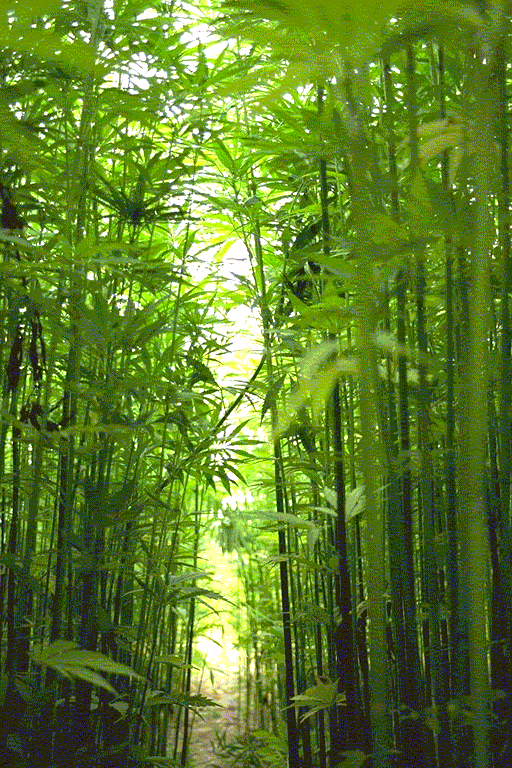 Industrial hemp also grows differently than marijuana: Hemp is typically grown upwards, not
outwards, because the focus is not on producing buds but on producing length of stalks. In this way, hemp is a very similar crop to bamboo. The stalk contains the fibre and hard, woody core material that can be used for a variety of purposes, even carpentry.
Generally, THC-producing marijuana plants are grown to an average of five feet in height, whilst industrial hemp on the other hand is grown to a height of ten to fifteen feet before harvest. Also, it is fairly difficult to grow concealed marijuana within industrial hemp crops as the DEA* alleges.
Since industrial hemp is grown so close together and is generally a very narrow, vertical growth crop, any THC-producing marijuana would stick out like a sore thumb. Its wide growth would require a large amount of space to itself in order to get adequate sunlight from beyond the tops of the competing industrial hemp plants.
 The two also differ in the areas that they can be effectively grown. THC-producing marijuana must be grown in generally warm and humid environments in order to produce the desired quantity and quality of THC-containing buds. However, since industrial hemp does not contain these buds and the hardy parts of the plant are the more desired, it can be grown in a wider range of areas.
Generally, industrial hemp grows best on fields that provide high yields for corn crops. Furthermore, since industrial hemp can use male plants as well as female plants (since the object is not THC production), higher crop yields can result.
Hemp also has little potential to produce high-content THC when pollinated. As long as industrial hemp plants are pollinated by members of their own crop, then the genetics will remain similar with low levels of THC.
One would have to place several marijuana plants in close vicinity in over several generations in order to alter the genetics substantially of the offspring.
Since there are so many differences between industrial hemp and
THC-marijuana, it seems to make sense that it would be a fostered,
rather than demonized crop.
THC-marijuana, it seems to make sense that it would be a fostered,
rather than demonized crop.
For a crop that has little-to-no potential to get people high,
the current attitude is both irresponsible and draconian.

Industrial hemp could transform the economy GLOBALLY in a positive and beneficial way and therefore should be exploited to its full potential!
Source:
http://www.associatedcontent.com/article/91602/differences_between_industrial_hemp.html?cat=37 (with some adjustments)
*DEA: The Drug Enforcement Administration (DEA) is a United States federal law enforcement agency under the U.S.Department of Justice, tasked with combating drug smuggling and use within the United States.
Subscribe to:
Posts (Atom)